Free pronunciation lesson
Mandarin tones: a chart and practice guide for English speakers
A Mandarin tone is a pitch pattern attached to a syllable. Changing the tone can change the word. Start by hearing the direction of the pitch, then practice keeping that pattern while saying the syllable.
The four Mandarin tones
The marks above pinyin vowels are reminders of pitch movement. Keep the syllable the same while practicing a contrast: for example, compare mā with mà. The difference is in the voice’s pitch, not simply its volume.
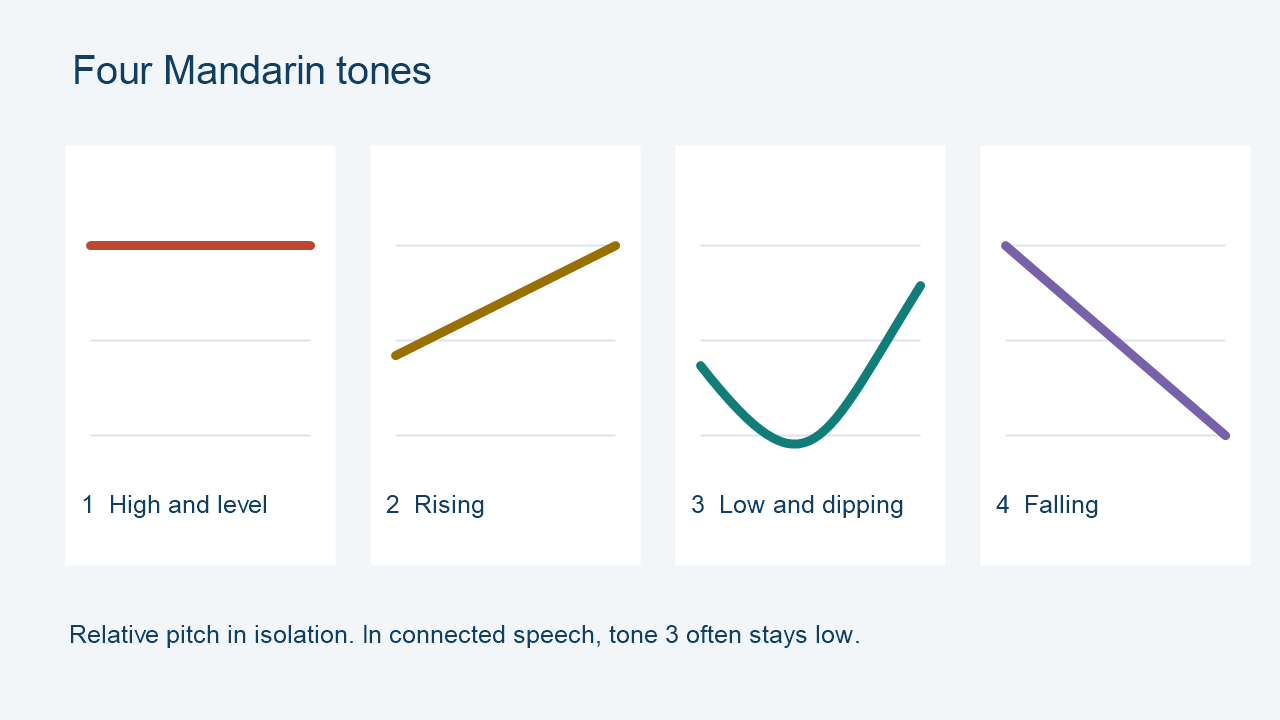
| Tone | Pinyin | Example meaning | Pitch cue |
|---|---|---|---|
| First | mā | Mother | Stay high and level. |
| Second | má | Hemp | Rise from the middle. |
| Third | mǎ | Horse | Go low; the full isolated form rises afterward. |
| Fourth | mà | To scold | Fall from high to low. |
| Neutral | ma | Question particle | Keep it brief and light. |
For a listening model, use the Open University’s introductory tone lesson and recordings. Listen before repeating, then return to the chart to describe what you heard.
Is the neutral tone a fifth tone?
Mandarin has four main lexical tones, plus the neutral tone. You may see it called the “fifth tone,” but it does not have one fixed pitch contour like the four full tones. Its pitch depends on the preceding tone, and it is typically shorter and lighter. In ordinary pinyin it has no tone mark.
A useful distinction: an unmarked syllable in correctly written pinyin can indicate a neutral tone; a whole sentence typed without any tone marks may simply be missing pronunciation information. Learn the word from a reliable dictionary or recording rather than guessing from unmarked text.
Second tone vs. third tone: what should you listen for?
For the second tone, listen for an upward movement. For the third, pay attention to the low part. A fully pronounced third tone in isolation can end with a rise, which makes the two easy to confuse if you listen only to the ending.
Try alternating má and mǎ with a recording. After each example, decide whether the important movement was a rise or a low dip. Then record your own pair and compare it with the model. If both sound alike, slow down and focus on the low portion of the third tone.
Why do tones sound different in a sentence?
A chart is a starting point. In connected speech, tones interact with neighboring syllables and with phrasing. The third tone frequently has a low realization without the complete final rise shown in isolation. For a detailed account of this variation, see Lee and colleagues’ study of Mandarin third-tone production and perception.
One common change is third-tone sandhi: when two third tones occur together in a simple pair, the first is pronounced with a rising, second-tone-like contour. For example, nǐ hǎo is conventionally written with two third-tone marks, while the first syllable changes in pronunciation. Longer sequences depend on grouping; avoid applying a simple pair rule blindly to an entire sentence.
Practice words in short phrases as well as in isolation. This helps you connect the dictionary pronunciation to what people actually say. The ebook also introduces tone changes involving bù and yī; this free lesson focuses on the basic contours and the third-tone contrast.
A ten-minute Mandarin tone practice routine
Use this as a repeatable session, adjusting the pace to your comfort. Ten minutes is a practice structure, not a promise of mastery.
- Listen for two minutes. Choose a small set of recorded syllables. Look away from the pinyin and identify the tone before checking.
- Trace and repeat for two minutes. Follow the contour with your hand as you repeat. Keep a comfortable voice; do not force extreme high or low notes.
- Contrast one pair for two minutes. Pick a confusion such as second versus third tone. Alternate the two using the same syllable.
- Record and compare for two minutes. Listen to the model, then your recording. Note one specific difference in pitch movement.
- Use a short phrase for two minutes. Repeat a phrase from the same source, preserving its rhythm. Write down the contrast to revisit next time.
Common practice mistakes
- Changing loudness instead of pitch. A louder syllable is not automatically a higher tone.
- Always adding a full dip and rise to tone three. Listen to the word in its actual phrase.
- Reading without listening. Tone marks help you remember a sound; they cannot supply all the details of a pronunciation model.
- Repeating an uncertain sound many times. Pause and compare with a reliable recording or ask a teacher for feedback.